Try it for free
·
Brian Ochoa
The Evidence Archaeology Trap: Why Gut-Feel Still Rules the Roadmap
52% of product managers admit gut feel still drives their roadmap more than data. Here's why evidence archaeology keeps teams stuck — and how to break the cycle for good.

The Evidence Archaeology Trap: Why Gut-Feel Still Rules the Roadmap
Today’s product teams are awash in data yet struggle to make decisive choices. The modern product management paradox is that the more data you gather, the more challenging it becomes to act on it.
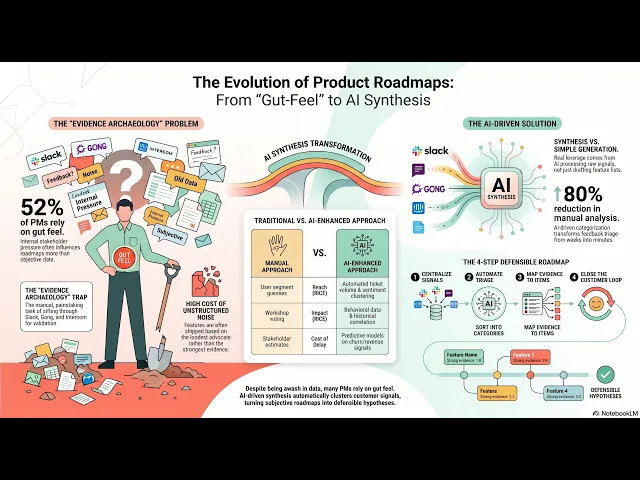
According to the 280 Group's Product Management Skills Benchmark Report (2023), 52% of product managers reveal that gut feel or internal stakeholder pressure influences their roadmap decisions more than objective data. While this figure is significant, it is not unexpected.
Evidence archaeology bridges this gap. It involves the painstaking task of sifting through Confluence pages, Gong call recordings, Intercom threads, and Slack DMs to find a single customer quote that validates a feature. Often, product managers abandon this search midway, defaulting to the loudest voice from the last planning meeting.
This is where the real cost lies. Without a robust product prioritization framework, stakeholder pressure fills the void. The shipped feature is rarely the one with the strongest evidence; it's the one with the most persistent advocate. Turning that unstructured noise into defensible decisions is precisely the issue AI is starting to address.
However, this shift goes beyond asking AI to simply "write a roadmap" — and that distinction is crucial for most teams to understand.
Beyond ChatGPT: The Evolution of AI in Product Prioritization
Generative AI tools can draft a roadmap in seconds, but a quick answer to the wrong question remains incorrect. Asking a large language model to "write a roadmap" yields a plausible-looking list of features influenced by generic training data, not your users' real pain points. The output seems productive but often isn't.
The real breakthrough in AI-driven product work isn't generation — it's synthesis. There's a significant difference between AI that generates content and AI that processes unstructured signals to uncover patterns that a human analyst might miss or take weeks to identify. Synthesis-based AI analyzes raw customer conversations from tools like Slack, Gong, and Intercom, clustering recurring themes, flagging sentiment shifts, and identifying emerging needs before they appear in formal feedback forms. This capability is fundamentally different and far more powerful for product leaders.
As Mind the Product notes, "a common mistake in AI product management is treating the roadmap as a list of features rather than a series of hypotheses to be validated through customer signals." This perspective is vital. By transitioning from a static feature list to a hypothesis-driven model, every roadmap item carries an assumption that can be tested, confirmed, or discarded — precisely where AI proves invaluable. Tools built around AI product roadmap prioritization can continuously reweight these hypotheses as new signals emerge, rather than waiting for a quarterly planning cycle.
This evolution also impacts established frameworks directly. Methods like WSJF prioritization rely heavily on estimating variables such as Cost of Delay, user value, and urgency — historically, these have been educated guesses. Synthesis-based AI can ground these estimates in real data, transforming judgment calls into defensible, signal-backed scores. The next section explores how these frameworks are being reimagined for an AI-native era.
Reimagining Traditional Frameworks: WSJF and RICE in the AI Era
Traditional prioritization frameworks were designed for a time when product teams could deliberate — AI now demands a faster, more accurate assessment of what those frameworks require.
The core issue with manual WSJF is that "Cost of Delay" is almost always a guess. Product managers estimate the value lost by waiting, but without real-time market signals or aggregated customer data, this number is more intuitive than evidence-based. The same weakness affects RICE: "Reach" and "Impact" scores often reflect whoever was most vocal in the last planning meeting.
AI fundamentally changes both inputs. Automated sentiment analysis across support tickets, review platforms, and user interviews can quantify how many customers are affected by a pain point — and how intensely. According to Gartner's Market Guide for Product Management Software, AI-driven categorization can reduce manual feedback analysis by up to 80%, transforming "Reach" from a gut estimate into a data-backed figure.
This thinking underlies what RICE-A introduces: an adaptation of the classic framework specifically designed for AI-driven features, incorporating model confidence, data availability, and automation leverage as scoring variables. It acknowledges that AI features carry unique uncertainty and integrates that nuance directly into prioritization.
Framework Input | Manual Approach | AI-Enhanced Approach |
|---|---|---|
Cost of Delay (WSJF) | Stakeholder estimate | Predictive models on churn/revenue signals |
Reach (RICE) | User segment guess | Automated ticket volume + sentiment clustering |
Impact (RICE) | Workshop voting | Behavioral data + historical feature correlation |
Effort (both) | Engineering gut-feel | Codebase analysis + sprint velocity modeling |
Among the best AI tools for product managers, the most valuable capability isn't drafting roadmaps — it's running impact forecasts before a single line of code is written. Predictive AI can model likely adoption curves and revenue lift based on similar past features, providing prioritization decisions with a probabilistic foundation rather than a narrative one.
The frameworks themselves aren't obsolete. What's changed is the quality of data feeding into them — which means the real opportunity lies in building the infrastructure to systematically capture and connect that data.
How to Prioritize Features in an AI-First Product Roadmap
Effective AI product roadmap prioritization isn't about choosing the loudest feature request — it's about creating a repeatable system that converts raw signals into defensible decisions.
Only 11% of product managers say they are "very effective" at closing the feedback loop with customers, which means most teams make roadmap decisions with incomplete information. The four steps below directly address that gap.
Step 1: Centralize fragmented signals Customer feedback resides in Jira tickets, Slack threads, Intercom conversations, and sales call notes simultaneously. Before any triage, these sources need to converge into a single layer. Without consolidation, patterns remain hidden, and high-signal moments are lost in the noise.
Step 2: Automate triage into strategic themes Once signals are centralized, AI can group tickets by intent rather than keyword. What seems like twenty separate bug reports may actually indicate one underlying usability failure. Automated theme detection surfaces this pattern in minutes instead of weeks.
Step 3: Map evidence directly to roadmap items Every feature on the roadmap should have a traceable link back to the evidence that justified it. This creates the defensibility stakeholders require — turning a subjective roadmap into a living document that updates as new data arrives.
Step 4: Close the feedback loop with customers Prioritization doesn't end at shipping. Customers who raised an issue need acknowledgment when it's resolved. This loop builds trust, drives retention, and generates the next round of high-quality signals.
Getting these steps right depends heavily on the tools doing the underlying work — which is precisely where the conversation turns next.
The Best AI Tools for Product Managers: From Synthesis to Execution
The real bottleneck in modern product development isn't engineering capacity — it's decision clarity. Teams can ship faster than ever, but deciding what to ship remains a manual process. Understanding how to prioritize features in an AI product roadmap means selecting tools that don't just generate text, but synthesize messy, distributed signals into defensible decisions.
When evaluating AI prioritization tools, three criteria matter most:
Integration — Does it connect to where your team already works (Slack, Jira, support queues)?
Synthesis — Does it surface patterns across calls, tickets, and threads, not just summarize individual items?
Defensibility — Does it produce evidence you can show a stakeholder, not just a confidence score?
This is where platforms built specifically for product intelligence earn their keep. GetSenso, for example, connects customer calls, tickets, and Slack threads to actual product behavior — turning scattered inputs into structured evidence that maps directly to roadmap decisions. That's a fundamentally different value proposition than a generic AI writing assistant.
"The best AI tools don't replace PM judgment — they eliminate the archaeology that delays it."
Tool fatigue is a real risk. Adopting another standalone platform that requires manual data exports defeats the purpose. The tools worth evaluating are those that integrate into existing workflows rather than requiring a parallel process. If a PM still has to copy-paste Slack threads into a separate dashboard, the synthesis layer has already failed.
Choosing well here sets the foundation for something bigger — rethinking not just which tools you use, but how your entire product strategy processes evidence.
The Bottom Line: Transforming Your Product Strategy
The bottleneck isn't engineering anymore — it's deciding what to build. As Senso puts it directly, the constraint on modern product teams is decision clarity, not shipping capacity. That reality makes every hour a PM spends manually digging through Slack threads, call recordings, and support tickets a direct cost to strategic output.
Looking across strong product roadmap examples from high-performing teams, a consistent pattern emerges: those shipping the right things aren't doing more research — they're doing smarter synthesis. AI doesn't replace PM judgment; it removes the noise so that judgment can operate on signal.
Here are the four takeaways to act on immediately:
Stop manual evidence archaeology. Triaging customer feedback by hand is a poor use of senior PM talent. Automate the aggregation layer so your team spends time interpreting data, not hunting for it.
Use AI to synthesize signals, not just generate text. The real leverage is pattern recognition across thousands of data points — not producing another feature brief. Tools that connect Gong calls, Jira tickets, and Slack conversations surface themes no human review process could match at scale.
Prioritize hypotheses backed by real customer data. According to Contentsquare, roadmap decisions grounded in behavioral evidence consistently outperform those driven by internal opinion or loudest-customer bias.
Adopt tools that integrate with your existing stack. A prioritization system is only as good as the data flowing into it. If your tool doesn't connect to where conversations actually happen, you're still working with incomplete evidence.
Each of these shifts compounds. Teams that automate signal collection make faster decisions, build more defensible roadmaps, and spend less time relitigating priorities with stakeholders. That compounding effect — from gut-feel to data-backed clarity — is exactly what the right infrastructure makes possible.
Conclusion: Achieving Roadmap Clarity with GetSenso
The shift from gut-feel to AI-driven prioritization isn't just a workflow upgrade — it's a fundamental change in how product teams earn stakeholder trust. Throughout this piece, the central argument has held: your roadmap is a hypothesis, and hypotheses need evidence, not instinct.
What makes that evidence-gathering tractable today is tooling that removes the manual burden entirely. GetSenso connects directly with Slack, Intercom, and Jira, automating the feedback triaging and roadmap justification that once consumed hours of a PM's week. Instead of combing through conversation threads or reconciling conflicting signals across tools, product managers get a continuous, structured picture of what customers actually need — surfaced automatically, without the archaeology.
The downstream benefit is a roadmap that speaks for itself. When every prioritization decision links back to real customer signals and quantified impact, stakeholders can't dismiss it as a hunch. That defensibility changes the nature of roadmap reviews — from debates about opinion to discussions about strategy. According to research on AI-driven prioritization models, integrating automated signal processing into the prioritization workflow directly reduces subjective bias in feature ranking. The roadmap becomes something the whole organization can orient around, not just the product team.
In practice, the teams that move fastest aren't those with the most engineering resources — they're the ones who spend the least time arguing about what to build next. GetSenso is built to close that gap. If your current process still relies on spreadsheets, gut calls, or whoever spoke loudest in the last planning meeting, now is the right time to change that. Start automating your prioritization with GetSenso — and turn your next roadmap from a guess into a defensible, data-backed plan.