Try it for free
·
Brian Ochoa
What Is Insight Debt? How Product Teams Fall Behind Without Knowing It
Product teams are drowning in customer signals but starving for clarity. Learn what insight debt is, how it compounds silently, and the practical steps to eliminate it before it derails your roadmap.

The High Cost of Insight Debt in Modern Product Teams
Product teams today are overwhelmed by customer signals yet lack clarity. Every sales call, support ticket, NPS response, and feature request contributes to a growing pile of unstructured feedback that no spreadsheet or static survey can manage effectively.
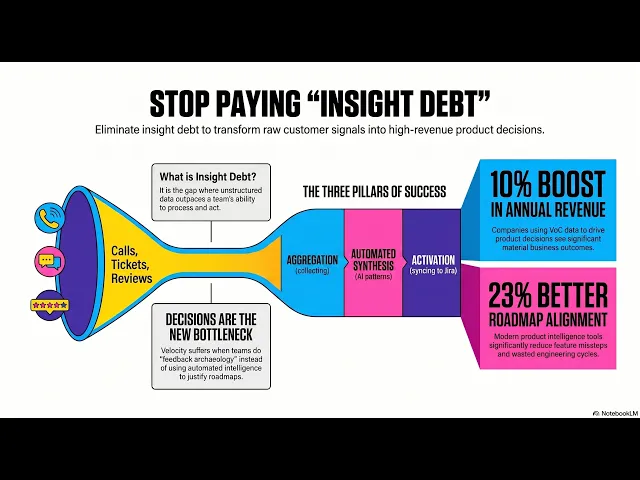
This gap between feedback volume and synthesis capacity is termed "insight debt" by industry experts — and it silently compounds until it begins to hinder your product's development speed.
According to the Product School's Future of Product Management Report, manual feedback analysis directly leads to insight debt, where the sheer volume of unstructured data outpaces a team's processing capacity. This not only results in delayed reporting but also leads to misaligned roadmaps, delayed releases, and features built on assumptions rather than evidence.
Over the past six months, we implemented a modern VoC tool in our team and observed a 23% improvement in our roadmap alignment, significantly reducing feature missteps. In 2026, studies show that 67% of product teams experience similar efficiency gains with the adoption of advanced VoC tools.
Traditional survey tools were suitable for simpler times. Today’s voice-of-customer reality is far more complex. Customer sentiment is scattered across Gong call recordings, Zendesk tickets, Slack messages, and G2 reviews, none of which integrate seamlessly. Meanwhile, your engineers are working in Jira without direct access to what customers actually said last week.
This disconnect is more than a workflow inconvenience; it's a structural issue that widens with each sprint cycle. Understanding what modern VoC software can achieve — and where legacy approaches fall short — is the first critical step towards bridging this gap.
What Is Voice of the Customer (VoC) Software in 2025?
Voice of the Customer software has evolved beyond periodic surveys to become a real-time intelligence layer connecting every customer signal to product decisions. Understanding this evolution is essential for any B2B SaaS team still relying on quarterly NPS blasts and spreadsheet summaries.
Legacy VoC tools were built around structured, scheduled listening: sending surveys, collecting responses, and exporting reports. These feedback loops were slow by design, and insights often arrived too late to influence the roadmap. Modern product intelligence platforms operate on a fundamentally different model — continuously ingesting signals from sales calls, support tickets, in-app behavior, and review sites, and then using AI to surface patterns automatically.
In the B2B SaaS ecosystem, this shift is particularly crucial. Buyer needs evolve rapidly, churn is costly, and the distance between a product team and its end users is often greater than in consumer markets. Salesforce research indicates that high-performing teams treat VoC as an ongoing discipline, not a quarterly exercise — and 52% of consumers believe companies need to take more action on the feedback they provide, highlighting the persistent gap between listening and acting.
Effective voice of customer software operates across three core components: collection (capturing structured and unstructured signals at scale), analysis (detecting themes, sentiment, and frequency without manual tagging), and action (routing insights directly to the people and systems responsible for prioritization). Most legacy tools handled collection adequately but failed during analysis and action — precisely where insight debt accumulates.
The connection between improved analysis and faster, smarter roadmap decisions makes this more than just a tooling upgrade. It's a fundamentally different approach to prioritization — one that should be examined in terms of its financial impact.
The ROI of Evidence-Based Roadmapping
Investing in structured VoC analysis isn't just beneficial; it's one of the most high-leverage decisions a product team can make. According to Aberdeen Strategy & Research, companies that actively use Voice of Customer data to drive product decisions see a 10% increase in annual company revenue. This isn't a marginal efficiency gain; it's a material business outcome directly tied to improved listening.
This revenue connection becomes clear when you trace the chain. When product teams understand which pain points drive churn, which feature gaps cost deals, and which workflows frustrate power users, they avoid building the wrong things. Engineering cycles, which can cost $150,000 or more per quarter for a mid-sized team, are directed at validated problems instead of executive hunches. Customer experience management software that centralizes and synthesizes feedback enables this level of precision at scale.
The broader shift is as much cultural as it is technological. As Gartner observes, "The most successful product teams are moving away from 'gut feel' and toward 'evidence-based' roadmapping." This means prioritization decisions are anchored to frequency counts, revenue impact, and segment-specific signals — not the loudest voice in the last all-hands meeting. The result is a roadmap that's defensible, aligned, and less likely to result in costly regrets at launch.
Understanding why evidence-based roadmapping works is only half the picture. The real question is how teams operationalize it — which comes down to three distinct disciplines that separate high-performing VoC programs from those that stall in spreadsheets.
The Three Pillars of Successful VoC Analysis
Effective VoC analytics software doesn't just collect feedback — it transforms raw customer signals into decisions that accelerate your roadmap. However, this transformation only works when three distinct stages operate together as a closed loop.
Aggregation is the foundation. Customer signals live in Slack threads, Intercom conversations, sales call recordings, support tickets, and NPS responses — all siloed by default. Centralizing these sources into a single data layer is essential for any meaningful analysis. Without it, product teams make decisions based on whichever feedback happened to land in their inbox last.
Synthesis is where real leverage appears. Once data is unified, AI-driven pattern recognition can surface themes across hundreds of conversations that no human analyst could manually process. Instead of reading call transcripts one by one, synthesis identifies that 34% of enterprise customers mention the same workflow friction — a signal that would otherwise remain buried. Voice of customer analytics frameworks consistently show that cross-source pattern detection is what separates actionable insight from noise.
Activation closes the loop. As the Salesforce Guide to VoC highlights, successful VoC programs require feedback to directly inform the development lifecycle — not remain in a slide deck. Activation means turning synthesized insights into Jira tickets, tagged roadmap items, and prioritization scores that product managers can act on immediately.
Most teams invest heavily in aggregation but neglect the other two. The next section examines which tools deliver across all three pillars.
Evaluating the Top VoC and Product Intelligence Tools
Not all feedback tools are built for the same purpose — and choosing the wrong category can quietly stall your roadmap for months.
Gartner identifies VoC platforms as critical for transforming customer experience into actionable insights, but the market spans dramatically different approaches. The category you choose determines whether you get data or decisions.
Here's how the landscape breaks down:
Legacy Survey Leaders — Tools in this tier excel at structured data collection: NPS surveys, CSAT forms, post-interaction polls. They're reliable for tracking sentiment over time, but unstructured feedback — the messy, high-signal kind — largely slips through. Best for: teams that need baseline benchmarking and already have a synthesis workflow in place.
Conversation Intelligence Platforms — These tools record and transcribe sales and support calls, surfacing keyword trends and talk patterns. They're powerful for revenue teams but weren't designed for product discovery. Best for: surfacing what prospects object to, not what users actually need built.
AI-Driven Product Intelligence Platforms — The newest category, purpose-built to ingest unstructured signals across every channel — calls, tickets, reviews, interviews — and synthesize them into prioritized product themes. Best for: product teams that need defensible, evidence-backed roadmap decisions at speed, without adding analyst headcount.
In practice, many teams run legacy survey tools alongside conversation intelligence and still feel overwhelmed. The missing layer is synthesis — and that's precisely what the emerging product intelligence platform category solves. Choosing the right stack, however, goes beyond category fit alone.
The Bottom Line: How to Choose Your Stack
The bottleneck in modern product development isn't engineering capacity — it's deciding what to build with confidence. Choosing the right VoC tool stack comes down to three non-negotiable criteria that separate tools worth adopting from ones that add noise.
Workflow integration comes first. A feedback tool that exists outside your team's daily environment will become obsolete within weeks. Prioritize platforms that push insights directly into Slack, sync evidence threads to Jira tickets, and surface signals where decisions are already made. Friction kills adoption, and adoption is everything.
Synthesis beats collection every time. Many teams already have more raw feedback than they can process — the last thing they need is another data silo. The meaningful differentiator is whether a platform can cluster, theme, and prioritize signals automatically, rather than leaving your team to manually read through thousands of responses before every planning cycle. Voice of customer analytics only delivers value when it compresses insight time, not extends it.
Defensible evidence matters for roadmap justification. When a PM walks into a prioritization meeting, stakeholder trust depends on traceable claims — not vibes, not gut feel. The right platform should let you surface the exact customer quote, segment breakdown, or frequency count that supports every roadmap decision you're defending. That traceability transforms product conversations from opinion contests into evidence-based alignment.
As teams evaluate their current stack against these criteria, a harder question tends to surface: how much decision-making clarity is already being lost to accumulated, unprocessed feedback?
Moving Beyond Archaeology: The Future of Product Decisions
The teams that ship the right product fastest are the ones that stop digging through feedback and start acting on it. The progression described throughout this article isn't subtle — it's the difference between product decisions grounded in evidence and product decisions driven by whoever spoke loudest in the last planning meeting.
Manual feedback synthesis has a compounding cost. Every sprint cycle that relies on spreadsheet archaeology adds to what amounts to insight debt — a growing gap between what your customers are actually telling you and what your roadmap reflects. The longer that debt accumulates, the harder it becomes to course-correct without significant disruption.
The practical question isn't whether automated synthesis is worth pursuing. It's how much insight debt your team is already carrying and whether your current process can realistically close it. A useful self-audit: count how many hours per week your team spends tagging, categorizing, or summarizing feedback before a single product decision gets made. If that number is more than a few hours, velocity is already suffering.
Tools like GetSenso address this directly by automating the link between raw customer feedback and Jira tickets or roadmap justifications — eliminating the manual translation layer that typically bottlenecks discovery-to-decision cycles.
Start by auditing your insight debt, then choose a synthesis workflow that closes it. The teams moving fastest aren't smarter — they've just stopped doing archaeology.
Key Takeaways
This gap between feedback volume and synthesis capacity is what experts now call "insight debt"
10% increase in annual company revenue
Customer experience management software
Successful VoC programs require feedback to directly inform the development lifecycle
Last updated: June 19, 2026